PodcastsToText Opens Its Transcription Engine to Developers and AI Agents With a REST API and a Hosted MCP Server
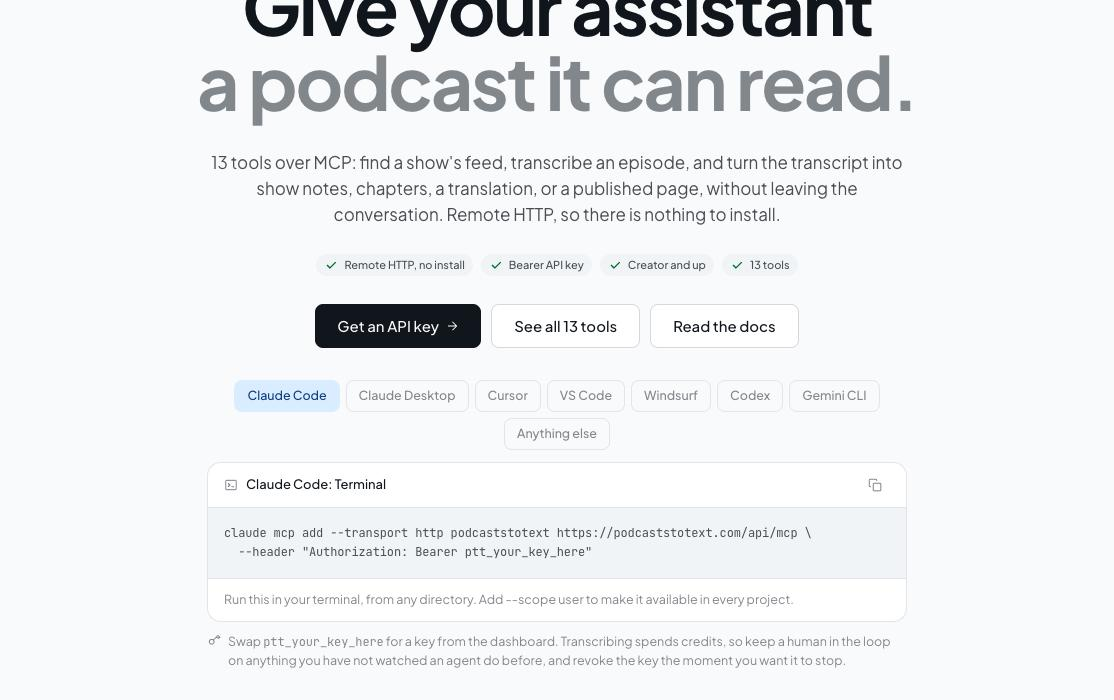
PodcastsToText has published a versioned REST API and a hosted Model Context Protocol server, giving software and AI assistants 13 tools to find, transcribe and read podcast episodes from a link rather than from an audio file.
- MCP tools
- 13
- Audio sources the API accepts
- 6
- Transcript formats the API returns
- 6
- Recognition languages
- 101+
September 25, 2026 —
PodcastsToText has opened its transcription engine to software. A versioned REST API now exposes the same pipeline the web studio runs on, and a hosted Model Context Protocol server gives AI assistants 13 tools for finding, transcribing, reading and publishing podcast episodes on their user's behalf.
Both front doors sit on one account. There is no separate developer plan, no second subscription and no second billing relationship: a key issued from the dashboard spends the same balance the studio does.
What changed
- A REST API with a published OpenAPI specification. Create a transcription from a URL or an upload, poll it, read it back in any supported format, list and delete, look up a podcast or its feed, generate chapters and show notes, translate, publish an episode, and read the account's remaining balance. The machine-readable spec is served at `/api/v1/openapi.json`.
- Webhooks with a delivery log. A transcription that finishes ten minutes later does not need polling. Every delivery is recorded and a failed one can be retried from the API, so an outage on the receiving end is recoverable rather than silent data loss.
- A hosted MCP server, version 2.2.0, at
/api/mcp. It is a remote server, so most clients need one line of configuration and no local install. An npm package bridges the clients that still speak only local stdio. - Scoped API keys. A key carries scopes, and a call outside them is refused at the gate rather than deep inside the handler. The dashboard shows which keys are in use, when they last called, and revokes them.
- An agent skill. A single document describing the whole tool surface, so an assistant can be told what the server does without being walked through it.
Why it matters
Speech-to-text APIs expect you to already have the audio file. That is the wrong starting point for podcasts, where what you have is a Spotify or Apple Podcasts link and the audio is behind a feed you have to find first. Anyone building against a generic transcription API has to write the resolution layer themselves: find the show, find the episode, find the enclosure URL, handle the platforms that do not publish one.
This API takes the link. Resolution, audio retrieval, transcription, diarization and the generated outputs are one call and one bill, and the same resolution work the studio does is what the API does.
The MCP server matters for a different reason. An assistant that can transcribe a podcast can answer questions about episodes that have never been written down, which is most of them. Exposing the engine as tools rather than as a chat integration means the assistant does the reasoning and we do the transcription, and the user's own account and balance are what get spent.
One deliberate asymmetry: a YouTube video that already has a caption track costs nothing on the API, because no transcription actually runs. That is a published guarantee in the specification, not a temporary promotion.
Availability
The API and the MCP server are on Creator, Pro, Studio and Podmaxxing Keys are created in the dashboard and work immediately. The reference is at podcaststotext.com/docs, the platform overview at /developers, and the agent surface at /mcp.
“Every transcription API I looked at started at the audio file, which meant the first thing anyone building on one had to write was the boring half: resolve the show, find the episode, dig the audio URL out of the feed, and special-case the platforms that do not publish one. That is the part we had already solved, so that is the part we opened. Giving the same thing to agents over MCP was almost the same work, and it means an assistant can answer a question about an episode nobody has written down.”
PodcastsToText turns spoken audio into text people can actually use. Paste a Spotify, Apple Podcasts, YouTube or TikTok link, or upload a file, and it returns a timestamped transcript with speaker labels, then an editing studio that generates chapters, show notes, summaries and social copy from it. The same engine is available to developers as a REST API and to AI agents as a hosted MCP server. It was founded in 2025 by Marios Stylianou and is self-funded.
Marios Stylianou
marios@podcaststotext.com
Press kit, logos and fast facts